
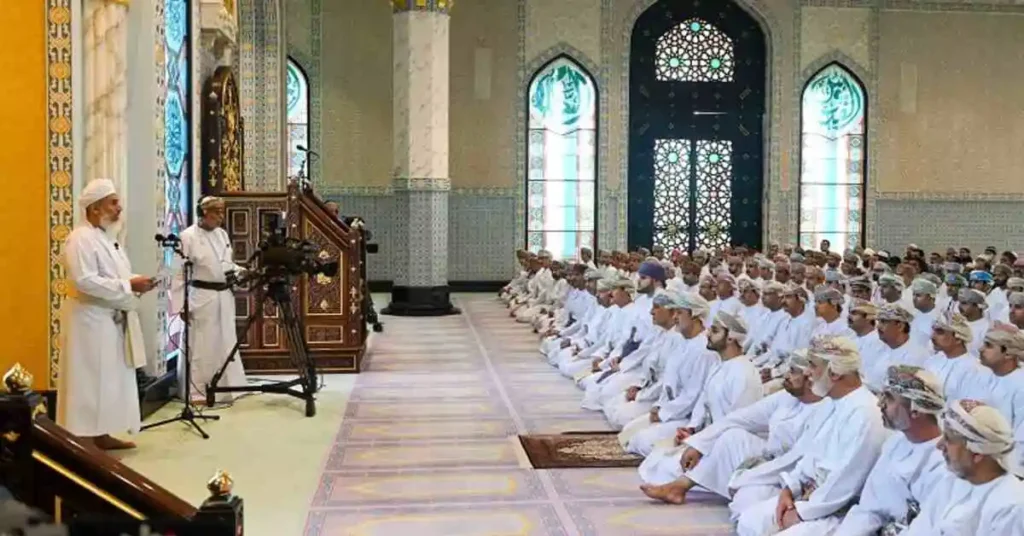
Finding the right prayer time in Oman doesn’t have to be complicated. Whether you call it Salah, prayer, or namaz – what matters is praying at the correct time. If you’re in Muscat’s busy streets, enjoying Salalah’s beautiful beaches, working in Sohar, or exploring Nizwa’s historic forts, knowing exact namaz times keeps you connected to your faith every single day. Check Kuwait prayer times here.
This complete guide gives you everything about Oman prayer times. Simple words, clear information, and accurate timings that help you never miss a prayer.
Today’s Prayer Time in Oman
Here’s what you need right now – today’s accurate namaz time across Oman’s main cities.
Muscat Prayer Time Today:
- Fajr: 5:00 AM
- Dhuhr: 11:56 AM
- Asr: 3:05 PM
- Maghrib: 5:27 PM
- Isha: 6:40 PM
Salalah Namaz Time Today:
- Fajr: 5:00 AM
- Dhuhr: 12:15 PM
- Asr: 3:38 PM
- Maghrib: 6:17 PM
- Isha: 7:47 PM
Sohar Prayer Time Today:
- Fajr: 4:46 AM
- Dhuhr: 12:03 PM
- Asr: 3:28 PM
- Maghrib: 6:02 PM
- Isha: 7:32 PM
Nizwa Namaz Time Today:
- Fajr: 3:58 AM
- Dhuhr: 12:13 PM
- Asr: 3:31 PM
- Maghrib: 6:59 PM
- Isha: 8:29 PM
You’ll notice Salalah and Nizwa have quite different times from Muscat and Sohar. That’s because Oman is geographically diverse – Southern cities like Salalah and interior cities like Nizwa have different sunrise and sunset patterns. Check Saudi Arabia prayer times here.
Understanding Prayer Times and Namaz Times in Oman
Prayer time and namaz time mean the same thing. Different Muslim communities use different words, but they all refer to the five daily Salah that form the backbone of Islamic worship.
These times aren’t picked randomly. They follow the sun’s position across the sky throughout the day. This beautiful system means Muslims everywhere pray at the same relative moments, creating a global rhythm of worship.
Oman follows Islamic prayer calculations approved by the Ministry of Endowments and Religious Affairs. This official oversight ensures that everyone in the country has access to accurate namaz times they can trust and follow.
The five daily prayers mark different parts of your day. From the quiet pre-dawn Fajr to the peaceful night Isha, each prayer has its own special window and spiritual purpose.
Fajr Prayer Time in Oman
Fajr is your first prayer of the day, happening before sunrise when the sky starts showing its first light. In Muscat, that’s around 5:00 AM right now. In Sohar, it’s slightly earlier at 4:46 AM. In Salalah, it’s also 5:00 AM, while Nizwa has the earliest Fajr at 3:58 AM.
Why does Nizwa have such an early Fajr time? It’s because of the city’s interior location and higher altitude. Geographic factors affect when dawn appears in the sky.
Fajr namaz time is special. Most people are still sleeping, but you’re awake, standing before Allah in those quiet moments. There’s something peaceful about starting your day with prayer. It’s like setting your spiritual compass before the world gets busy.
The Fajr window starts at dawn and closes when the sun actually rises. This gives you about an hour to complete the prayer. Many people find waking up for Fajr challenging at first, but it becomes easier with practice and brings tremendous blessings.
Dhuhr Namaz Time in Oman
Dhuhr comes right after the sun passes its highest point in the sky. This is the midday prayer that falls around 11:56 AM in Muscat, 12:03 PM in Sohar, 12:13 PM in Nizwa, and 12:15 PM in Salalah.
For working people in Oman, Dhuhr prayer time is usually the lunch break prayer. Many offices have designated prayer rooms, and it’s common to see colleagues taking a break to pray. This pause actually helps refresh your mind for the afternoon ahead.
The timing makes perfect sense spiritually too. Halfway through your busy day, you stop to remember Allah. It’s like pressing a reset button that helps you maintain balance between worldly responsibilities and spiritual obligations.
Shops and some businesses in Oman may close briefly for Dhuhr prayers, especially in smaller towns. This shows how prayer times shape daily life throughout the country.
Asr Prayer Time in Oman
Asr is your afternoon namaz, falling between 3:05 PM and 3:38 PM depending on which Omani city you’re in. This prayer comes during late afternoon when shadows start growing longer.
Asr prayer time marks that transition period from the productive day toward evening. Your work might be winding down, but Asr reminds you to maintain your spiritual connection even as tasks pile up.
There are actually two methods for calculating Asr – the Standard method (Shafi, Hanbali, Maliki) and the Hanafi method. Oman generally follows the Standard method, which most Muslims worldwide use. The Hanafi method would give a slightly later Asr time.
Many people in Oman try to pray Asr early in its window rather than delaying it. This is based on Islamic teachings that emphasize praying each salah promptly when its time arrives.
Maghrib Prayer Time in Oman
Maghrib happens immediately after sunset. In Muscat, that’s around 5:27 PM. In Sohar, it’s 6:02 PM. Salalah sees Maghrib at 6:17 PM, while Nizwa has it at 6:59 PM.
These significant differences in Maghrib time across Oman show how geography affects prayer schedules. Salalah, being in the south, has different sunset timing than northern coastal cities or interior mountain regions.
Maghrib namaz time holds special importance. During Ramadan, Maghrib marks when you break your fast. The sound of the Maghrib Adhan (call to prayer) brings families together for Iftar. Even outside Ramadan, Maghrib often signals the end of the workday and the beginning of family time.
The window for Maghrib is shorter than other prayers – lasting until twilight completely disappears. That’s why Muslims try to pray Maghrib soon after the Adhan. Delaying it too much means you might miss the optimal time.
Isha Namaz Time in Oman
Isha is your final prayer of the day, happening after twilight fades completely. In Muscat, Isha time is around 6:40 PM. Sohar has it at 7:32 PM, Salalah at 7:47 PM, and Nizwa at 8:29 PM.
Completing Isha means you’ve fulfilled all five daily prayers. Many Muslims feel a sense of peace and accomplishment at this point. You’ve maintained your spiritual obligations from dawn until night.
During Ramadan, Taraweeh prayers happen after Isha. These special Ramadan prayers bring the community together in mosques throughout Oman. The atmosphere during Taraweeh is beautiful – the recitation of the Quran, the collective worship, the spiritual energy.
After Isha, some people also pray optional Tahajjud prayers late at night, though that’s not obligatory. Isha essentially wraps up your day of prescribed prayers, letting you rest with a clear conscience.
How Prayer Times Are Calculated in Oman
Oman’s prayer times are determined by the Ministry of Endowments and Religious Affairs, which is the official authority for all religious matters in the country.
The calculations use precise astronomical data based on the sun’s position relative to your location. Each city’s exact latitude, longitude, and altitude are factored in. That’s why Muscat, Salalah, Sohar, and Nizwa all have different namaz times.
Most calculation methods in Oman follow the Umm al-Qura method from Saudi Arabia, which uses specific angles for determining Fajr and Isha times. For Asr, the Standard juristic method is typically used.
Modern technology makes these complex calculations automatic. Prayer apps use your GPS location to give you exact times without you needing to understand the math behind it. This convenience helps everyone stay on schedule regardless of where they are in Oman. Check UAE prayer times here.
Why Accurate Prayer Times Matter
Praying at the correct time isn’t just about convenience – it’s a fundamental part of the prayer’s validity. Each prayer has a specific window that starts and ends at precise moments based on the sun’s position.
If you pray too early, before the window opens, your prayer technically isn’t valid. If you pray too late, after the window closes, you’ve missed the prescribed time. That’s why accuracy matters so much.
In Oman, where daily life moves at a good pace between work, family, and social obligations, having accurate namaz times helps you plan your day properly. You can schedule meetings around prayer times, set phone reminders, and never feel rushed or unprepared.
Accurate prayer times also strengthen community bonds. When everyone follows the same schedule, it creates unity. You know your neighbors, coworkers, and family members are all praying at the same moments throughout Oman.
Prayer Times During Ramadan in Oman
Ramadan brings special attention to certain prayer times, particularly Fajr and Maghrib.
Fajr marks when your fast begins. Muslims wake up before Fajr time for Suhoor – the pre-dawn meal that gives energy for the day ahead. You stop eating a few minutes before Fajr to ensure you’re safely within the fasting time.
Maghrib is when you break your fast with Iftar. The moment the Maghrib Adhan sounds, dates are eaten, water is drunk, and families gather around the table. In Oman, this is a special time of community and sharing.
During Ramadan, mosques throughout Oman – from Muscat’s Grand Mosque to small neighborhood masjids in Sohar and Nizwa – host Iftar gatherings. Breaking fast together strengthens bonds and reinforces the spiritual atmosphere of the holy month.
Taraweeh prayers after Isha are a Ramadan tradition. These longer prayers involve reciting significant portions of the Quran throughout the month. The collective worship experience during Taraweeh is something every Muslim in Oman looks forward to.
Best Apps for Oman Prayer Times
Technology makes tracking namaz times incredibly easy. Here are the most popular apps used throughout Oman:
Muslim Pro is probably the most downloaded prayer app worldwide. It automatically detects your location anywhere in Oman and provides accurate prayer times. You get Adhan notifications, Quran features, Qibla direction, and more.
Athan focuses on the essentials – giving you accurate namaz times and playing beautiful Adhan calls five times daily. It’s simple, clean, and does exactly what you need without overwhelming features.
Islamic Finder is excellent if you travel around Oman. Whether you’re in Muscat for work, visiting Salalah’s beaches, or exploring Nizwa’s souqs, it adjusts automatically to give you local prayer times.
Salaat Times offers detailed monthly calendars you can print. Many people like having a physical copy of the month’s namaz schedule posted on their wall or refrigerator.
Most apps let you customize notification settings. You can choose different Adhan sounds, set reminders 5-10 minutes before each prayer, and select your preferred calculation method.
Prayer Time Differences Across Oman Cities
You’ve noticed that Muscat, Salalah, Sohar, and Nizwa have quite different namaz times. Let’s understand why.
Geographic Location: Oman stretches from north to south and from coast to mountains. This geographic diversity creates significant prayer time variations. Salalah, being far south, has very different sunrise and sunset times compared to northern cities.
Altitude: Nizwa sits at a higher altitude in Oman’s interior mountains. Higher elevations see dawn earlier and dusk later, which is why Nizwa’s prayer times differ notably from coastal cities.
Latitude: The further south you go in Oman, the later sunrise and sunset become relative to northern regions. That’s why Salalah’s times run later than Muscat’s.
In practical terms, if you’re traveling between Omani cities, always update your prayer app to your current location. A 30-minute difference in Fajr time means the difference between praying on time and missing the window entirely.
Finding Mosques in Oman
Oman has beautiful mosques throughout the country, making it easy to pray in congregation if you prefer.
In Muscat, the Sultan Qaboos Grand Mosque is magnificent – one of the world’s most beautiful mosques. It welcomes both worshippers and visitors (outside prayer times). You’ll also find neighborhood mosques in every area – Qurum, Ruwi, Al Khuwair, everywhere.
Salalah has the Al Saeed Mosque as a major landmark. Throughout the city, especially in residential areas, you’ll find mosques within walking distance. The city’s mosques are known for their welcoming atmosphere.
Sohar has numerous mosques serving the local community and the many expats working in the area. The historic mosques in Sohar’s old town are particularly beautiful with traditional Omani architecture.
Nizwa is known for its historic mosques that blend seamlessly with the city’s traditional character. The area around Nizwa Fort has several beautiful old mosques worth visiting.
Beyond mosques, many malls, airports, offices, and public buildings in Oman have designated prayer rooms. You’re never far from a place to pray.
Prayer Times Resources and Tools
Besides apps, several resources help you track namaz times in Oman.
The official Ministry of Endowments and Religious Affairs website publishes prayer times for all Omani cities. This is the gold standard for accuracy since it’s the government authority.
Times of Oman and other local newspapers print daily prayer times. Many people check these while reading morning news with their coffee.
Mosque calendars – Most mosques distribute printed monthly prayer timetables. You can pick one up and hang it at home or keep it in your car.
Radio announcements – Omani radio stations announce prayer times throughout the day. If you’re driving, you’ll hear reminders before each prayer.
Prayer time widgets – Most smartphones let you add prayer time widgets to your home screen. This means you see the next prayer time without even opening an app.
Frequently Asked Questions About Oman Prayer Times
How often do prayer times change in Oman? Every single day. The changes are usually small – just a minute or two daily – but they happen because of Earth’s rotation and seasonal changes.
Why are there big differences between cities like Muscat and Nizwa? Geography and altitude. Nizwa is in the mountains while Muscat is coastal. These geographic differences create 20-30 minute variations in prayer times.
What’s the difference between prayer time and namaz time? Nothing – they’re the same thing. Different Muslim communities use different words. “Salah” is Arabic, “Namaz” is Urdu/Persian, but all refer to the five daily Islamic prayers.
Can I pray before the scheduled time? No, each prayer has a specific start time you cannot pray before. But once the time begins, you have a window before the next prayer starts.
What if I miss a prayer time? Make it up (Qada) as soon as possible. Life happens and Islam understands that, but making up missed prayers is important.
Do Oman prayer times follow Saudi Arabia? Generally yes – Oman often uses similar calculation methods to Saudi Arabia, but exact times differ based on each location’s coordinates.
Are there prayer time adjustments during Ramadan? The prayer times themselves don’t change during Ramadan, but people pay extra attention to Fajr (for starting the fast) and Maghrib (for breaking it).
Five Pillars of Islam and the Importance of Salah
Prayer (Salah/Namaz) is the second of Islam’s Five Pillars, right after the declaration of faith. This placement shows how central prayer is to Muslim life.
The five pillars are: Shahada (faith declaration), Salah (prayer), Zakat (charity), Sawm (Ramadan fasting), and Hajj (pilgrimage). Among these, prayer is unique because you perform it five times every single day.
While Hajj happens once if you’re able, and Ramadan comes once yearly, prayer is your constant daily connection to Allah. It’s the spiritual backbone that supports everything else in your Islamic practice.
Living in Oman, where mosques dot the landscape and the Adhan echoes five times daily, makes maintaining these prayers easier. The society supports and respects prayer times, which is a blessing not every country offers.
Preparing for Prayer in Oman
Before praying, you need Wudu (ablution). This washing ritual involves cleaning your hands, face, arms, head, and feet. It purifies you physically and spiritually before standing before Allah.
All mosques in Oman have excellent Wudu facilities with clean running water. Even in remote areas, you’ll find proper ablution spaces.
You also need appropriate clothing. Men should cover from navel to knees at minimum. Women should cover everything except face and hands. In Oman, where modest dress is the cultural norm, this usually isn’t an issue.
Prayer direction matters too – you must face the Qibla (direction of Kaaba in Mecca). All Omani mosques have Qibla markers. If you’re praying elsewhere, use your phone’s compass or prayer app to find the correct direction.
The Call to Prayer in Oman
One of the most beautiful sounds in Oman is the Adhan – the call to prayer that echoes five times daily from mosques throughout the country.
The Adhan announces that prayer time has arrived and invites everyone to come worship. In cities like Muscat, you might hear it from multiple nearby mosques, creating a beautiful layered effect.
The Adhan’s words are powerful: declaring Allah’s greatness, testifying to His oneness and Muhammad’s prophethood, and calling people to prayer and success. These words have been called out for over 1,400 years.
For Fajr, there’s an extra phrase: “Prayer is better than sleep” (As-salatu khayrun minan-naum). This gentle reminder helps people wake up for the dawn prayer.
Many prayer apps offer different Adhan styles – you can choose the Mecca Adhan, Medina Adhan, or traditional Omani style. It’s a nice personal touch while ensuring you never miss prayer time.
Living in Sync with Namaz Times
Life in Oman naturally flows around prayer times. You don’t fight against them or try to squeeze prayers into impossible gaps in your schedule. Instead, your daily routine builds around the five prayers.
Morning routines start after Fajr. Work happens between prayers. Meetings pause for Dhuhr. Afternoon productivity fills the time between Dhuhr and Asr. Evening activities begin after Maghrib. Late gatherings work around Isha.
This rhythm becomes second nature quickly. You learn to estimate how long you have between prayers for various activities. You plan shopping trips knowing stores might close briefly for prayer. You schedule appointments with prayer times in mind.
Social life respects namaz times too. If you’re invited to someone’s home, the gathering will be timed around prayers. Nobody schedules important events during prayer times. It’s just part of how life works in Oman.
This societal support for prayer is one of Oman’s blessings. The whole country pauses five times daily, creating a unique spiritual atmosphere that strengthens everyone’s connection to their faith.
Understanding Different Terms for Prayer
If you’re new to Muslim communities in Oman, you might hear different words for prayer times:
Salah – Arabic word for prayer, most commonly used
Namaz – Urdu/Persian word, widely used in South Asian Muslim communities
Salat – Another Arabic form
Azan/Adhan – The call to prayer
Wudu – Ablution/washing before prayer
Qibla – Direction of prayer toward Mecca
All these terms refer to the same Islamic practices. Oman has diverse Muslim communities – Omanis, Pakistanis, Indians, Bangladeshis, Arabs from other countries – so you’ll hear various terms used interchangeably.
What matters isn’t which word you use, but that you pray on time!
Conclusion
Prayer times in Oman are easy to follow once you have the right tools and understanding. Whether you call it prayer time, namaz time, or salah time, what matters is maintaining that spiritual connection five times throughout your day.
Remember these key points: prayer times change daily, each Omani city has different times based on location, the Ministry of Endowments and Religious Affairs provides official timings, and multiple reliable apps and resources keep you updated.
Living in Oman gives you unique advantages for maintaining your prayers. A society that respects and accommodates prayer times, beautiful mosques throughout the country, and a spiritual atmosphere that encourages worship – these blessings make it easier to stay connected to your faith.
From Muscat’s bustling capital life to Salalah’s peaceful beaches, from Sohar’s industrial energy to Nizwa’s historic charm, your five daily prayers remain constant. They’re your personal appointments with Allah, moments of peace in busy days, and spiritual fuel that keeps you grounded.
Make namaz times your priority. Set your phone notifications, keep apps updated, check times daily, and never miss these precious moments with Allah. The reward isn’t just spiritual peace in the hereafter – the tranquility and purpose you feel today make every prayer worth it.
May Allah accept all our prayers and make it easy for us to maintain this beautiful practice throughout our lives in this blessed land of Oman.

Hi, I’m Haseeb Ahmed, the founder of KhaleejBlog.com — a premier travel platform dedicated to providing practical and up-to-date travel tips across Dubai, Saudi Arabia, Oman, and Qatar. My mission is to help travelers explore the Gulf region with ease, discover hidden gems, and make the most of every journey.


